11.7.12

Ice Cream is pretty cool, ish

In this country, they have many delicious snack foods that I quickly get obsessed with. They also rotate flavors seasonally, or randomly it sometimes seems. A couple of months ago, I stopped at my local conbini Family Mart to grab my favorite ice cream snack at the time, a crunchy banana chocolate ice cream popsicle thing. Unfortunately, the season had ended for those, I haven't seen the banana flavor since, only normal vanilla, and last week coffee. Delicious! but I digress.

Since they didn't have what I wanted, I was left with a hard decision, forgo the ice cream or get something else. I thought long and hard about it for about 3 seconds and decided to get something else.

When Steve and I were in Kyoto in the spring, he bought ice cream that you "drink" that I remembered thinking wasn't bad. There it was, sitting in the cooler in a tasty looking Cappuccino flavor. I decided to try it out.

Behold, the tasty treat: Coolish!

Mmm, coffee flavored frosty

What in the world is Coolish you ask? A very good question. The packaging calls it "飲むアイス" or ice cream drink. Drinkable ice cream. When you get it, you have to let it melt a little bit, and then you suck it up through the nozzle at the top of the package. If you don't let it thaw out a little bit, you will give yourself a massive headache and a sore jaw, and still not to get to eat (drink?) it until it thaws. Be careful!

Coolish is not technically ice cream. It's what some people call milk ice. It's like milk with tons and tons of tiny pieces of ice in it. Basically, it's a frosty in packet form. As a former Wendy's employee, frequent Wendy's eater when in America, and avid Wendy's misser (is that a word?) when in Japan, I was filled with joy at this discovery! Plus, since it's milk ice, not ice cream, it's fewer calories. Nice!

Obviously, I have quickly become obsessed with Coolish, especially now that it's getting so darn hot and humid here. Of course, in typical Japanese flavor fashion, there are 2 flavors of Coolish at a time. Vanilla, and whatever the flavor of the moment is. Sometimes if you visit stores like Wellness or grocery stores, they haven't sold out of all of the previous flavor yet, so you have a choice of 3 flavors! Lucky!

That's how I got to sample the Belgian chocolate flavor. It was out before Cappucino, but I found one hidden in with the Cappucino flavor at Yayoi (a local grocery store.)

It was a rich chocolate flavor. Not my favorite, but not bad.
One day, I went to get a Cappuccino Coolish and was sad to discover they were gone, replaced by the next flavor, Strawberry yogurt. True to it's name, the consistency was a little more yogurty, and it tasted like yogurt. As in a yogurt cup that was frozen, not frozen yogurt. There's a difference. I wasn't a fan.

If I wanted yogurt, I'd buy yogurt! I want ice cream darnit!

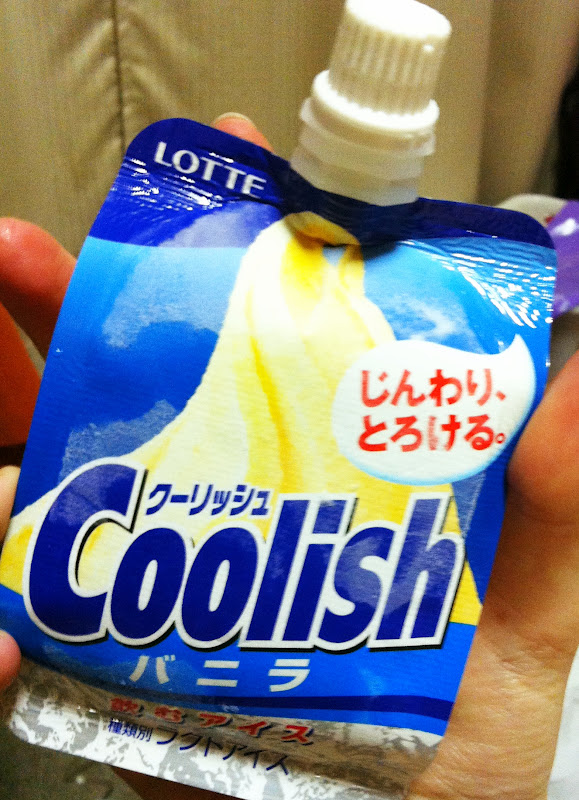
The next time I wanted Coolish, they still had the disappointing yogurt flavor, so I decided to try the original vanilla flavor that's always available. It was basically vanilla soft serve. Pretty good, nothing special.

Vanilla, always a classic.
Anyway, you can imagine the joy I felt when I walked in to Family Mart and discovered the newest flavor this week. Perfect for summer, it's Soda flavored Coolish!

Who decided soda is the color of windshield wiper fluid?

This blue soda flavor is pretty popular in Japan. There are lots of soda flavored candies, soda flavored soda, soda flavored I don't know what. I'm not really sure what soda flavor actually tastes like... It's kind of like Sprite but not so lemon lime. Maybe it's like cream soda? It's no cappuccino, but it's pretty tasty. And it's that fabulous blue color that makes me feel like I'm five again. The perfect summer treat!

10.7.12

Driving in Japan, pt 2

We last left off with the uncertainty of why exactly my American driver's license was good for only 3 years and roughly 7 months, when the Michigan driver's license rule book translated into Japanese CLEARLY states that Michigan driver's licenses are good for 4 years. Apparently, they decided I wasn't lying about my license or decided they just didn't care anymore, because they called my company and told them I passed my interview. Hooray! They made an appointment for me to take my written and practical driving exams, and that special day was today! The driving center only gives driving tests on Monday and Tuesday afternoons, or maybe only foreigners can test on those days, I don't know. I do know I had to leave my school halfway through to go take this test.

I arrived at the center to find my fellow ALT Ryan and our IC (i.e. translator, helper, all things awesome) Inoue-san. We went up to the second floor where we waited until it was exactly 1pm, when the office windows opened. We were informed we didn't have what we needed after all, so we got to go back down to the first floor and pay 2200 yen for the test,  and get our pictures taken in a little photobooth for 700yen. With our new papers and our tiny photos in hand, we got to go back upstairs and hand everything over. Then we were told to wait and they would give us our written tests in English.

Ryan and Inoue-san

Ryan and I got to take the test at the same time, at the same little table I had had my fun filled interview at the week before. The test was 10 maru batsu (O X, or true false) questions. Ryan had test booklet A and I had test booklet E, so we couldn't cheat. The English was a little special, and I felt like some of the questions were trick questions. For example, one question I had was: "It's illegal to go over 60 KMH on all roads other than expressways unless clearly marked by a maximum speed limit sign." Personally, I was thinking, well, yeah, you should go the speed limit, and I high doubt the speed limit is higher than 60 KMH unless you are on a highway... So I was thinking true. But then I thought, what if they want me to say "false, BECAUSE you should go the speed limit, not just under 60." These are the kind of problems I have, I second guess myself. I finished first and got sent back out into the hall to wait. Ryan came out a few minutes later and we waited for our results talking about the questions. To pass the written exam, you must get at least 7 answers correct. Neither Ryan or I were feel particularly secure. However, when they called us up to tell us our scores, we both got perfect 10s. Hooray!

After successfully passing our written tests, we got to take an eye test. The first part was which way does the C open, and then what color is showing. Ryan's color blind, so I was a little worried for him, but it was just red, yellow, and blue. (They have blue lights here, not green lights. Don't even get me started.) After we passed those, we were given maps of the course we were going to drive. On the course, there are 4 different routes to take, and today's route was the D route. The instructor told us that our packets had all the routes, so if we failed, we could take them home and study them all.

D course. We're gonna be all over that course


Let me interject here that no one I know of passes the driving test on the first try. Most people are either 2nd or 3rd. Sometimes it's 6. Apparently, when one of my fellow ALTs took theirs, there was a Chinese person there for their 18th try. So yeah, I wasn't really expecting to pass, but you can never stop that little blind hope that maybe it could happen to you, you'll be the one person to pass in 1 go! If and when you fail, you can set up an appointment to take the test again the following week. Only 1 driving test per week allowed.

Anyhoo, we got our maps and were told our driving order, and then got to go look out over the course to see what we were in for and to try and memorize the course. (Hah!)

The actual course


A Brazilian woman was driving first, and this was her second attempt to pass. Ryan was driving second, and I was driving third. Ryan got to sit in the backseat while the Brazilian woman drove, and I sat in the back while he drove. When I drove, the Brazilian woman sat in the back, just in case she didn't pass.

The course has different sections, a working traffic light, construction areas, and the crank and s turn section. Lots of places to turn, changes lanes, get confused, fail. Excellent.

Ryan went first and seemed to be doing really well, until he rolled through a stop sign. Instant fail, but the instructor let him finish the course to see what it was like for next time. Then it was my turn. I was super nervous, especially due to the lack of Japanese knowledge I have. I feel like I started off fine, and was going along, when the instructor gave me the next set of instructions it had a word I didn't know. I was thinking to myself what does that mean, and try to figure out when he stopped me and told me I just failed. I was like "say wha?" I had just turned into oncoming traffic. Woops! I'm pretty good about driving on the left side of the road when there's other cars and people around. It's really obvious to me what side of the road I should be on. But, then the road is completely empty with no signs, no people, and 5 lanes, I just reverted back to my American instincts. Sigh. He let me finish the course anyway, but I have to try again.

Afterward, he told us all how we did. The Brazilian woman passed, Ryan did perfect except for his stop sign, and I need to stay farther left or right depending on which direction I'm turning, make tighter turns, and not turn so fast. Although I must say, for that last part, the Japanese driving system is totally crazy. In America, I was taught to accelerate midterm, so the back of my car doesn't get slammed into by the people behind me. Makes sense, get out of the way. Here, it seems to be a contest of who can turn the slowest. I have almost rear ended ridiculously slow turners numerous times. It's just plain wrong. However, I want to pass and get my driver's license so I guess next time I'll be going at a snails pace. >.<  We'll see how that goes.

3.7.12

Driving in Japan, pt 1

As some of you may know, since I live in a super inaka part of Japan, (This means I live out in the middle of nowhere country side) I have a car to use to get around to my schools, as well as in my daily life. Sure, there are more middle of nowhere places in Japan, but the public transportation system in Matsue leaves much to be desired, hence cars.

Since I got my driver's license in America way back in m high school days, I'm allowed to drive here in Japan using my American license and an International Driver's license I got from AAA before I left. Peachy keen once I figured out how to drive on the wrong side of the road, read their Japanese road signs, and realized that in general, Japanese drivers do not actually know how to drive and love to randomly stop in the middle of roads constantly. But hey, as long as they turn on their hazard lights it's all good, right? However, the Japanese government says that's only cool for 1 year. If I want to stay in the country and keep driving longer than 1 year, I need a Japanese license. Yay.

To get a Japanese license, you can attend their driving course and then take the driving test at the amazing price of around $3000. What a deal! Or, if you have a license from another country that you've had for at least 6 months before moving to Japan, you can just switch over that license to a Japanese one for considerably less time and money.  Thank goodness for that, it should be easy peasy, right? I mean, I've already had my American license for approximately 10 years. Sadly, that depends on where you're from.

If you are from Australia, England, Canada, or a few other countries that are not America, you don't have to take a driving test. If you're from America and all the other countries in the world not on that short list, be prepared to drive around with a scary little Japanese driving instructor who is going to grade you harshly. Really harshly.

Let's backtrack and start at the beginning of the process, shall we?

Upon realizing that you are going to be in the country longer than 1 year, and your international license is going to expire soon, you should start the Japanese license acquiring process relatively soon. It can take a couple months to get it depending on if you actually need to go to your job and how bad the government feels like messing with you.

First, take a peek at your license. Does it have an issue date on it? If not, you should get an official letter from your government stating when you got it, because you have to be able to prove to the Japanese government you've been driving in your home country for at least 6 months. If you haven't, hope you are ready to shell out $3000 and a lot of time going to Japanese driving school. My Michigan license didn't have an issue date anywhere on it, so I had to ask the Secretary of State for a letter saying when I got it. I ended up not needing it, as the information was encrypted in a code and easily found when translated, but it's good to have, just in case.

If your license has an issue date, or you have a letter saying when that is, you can start the next step, which is to get your license translated into Japanese. The Japanese driving center doesn't speak your language, so you need to put everything into theirs. Makes sense. The easiest place to get your license translated is JAF, the Japanese equivalent of AAA. Take your driver's license, gaijin card, 3000yen, and a book to read while you wait. Despite their translating services, don't expect them to speak English unless you're in a big city. They just plug your license number into a computer program that does all the work. It should take about 30 minutes.

Once your license is all translated and good to go, you need to make an appointment at the driver's license center for an interview. For the interview you need the translation papers you got from JAF, your driver's license from your native country, your passport, your gaijin card, and your international driver's license. Make sure you show up 10-15 minutes early, and be prepared to spend some time sitting around waiting. When you arrive, they'll have you fill out a questionnaire filled with easily answerable questions like "What was the name of the person who gave you your driving test?" and "What is the exact date you started driving?" Of course, this is all in Japanese, so you better be super fluent, or bring a translator. My company sent a translator with me, thank goodness.

After filling out the approximately 20 questions about strange driving stuff that no one in their right mind would actually remember, especially if you're from America and got your permit over 10 years ago, you hand over the questionnaire and wait. Eventually, they'll be ready to see you and will invite you in to be interrogated.

The Japanese official will go over every single question on the paper and won't be able to understand why you don't remember events that happened 10 years ago when you were a teenager who didn't care how the system worked, it was just cool that you could drive. If you don't know the answers, obviously you are lying about something. They are equally distrusting about the fact that you don't know the secret interworkings of your own government. How many people actually know how long licenses are good for? When you get a thing in the mail saying renew, you renew, that's how long. For my interview, the man couldn't wrap his head around my license being good for 3 years and 7 months. In the paperwork, it says 4 years. Why is my license not for 4 years? (The reason being Michigan driver's licenses expire on your birthday, yet I got mine when I moved back to Michigan in February. I couldn't wait 7 months until my birthday and then get a license that lasted for exactly 4 years.) Yoshino-san (my translator) and I tried to explain it, but he didn't like that answer. Umm, okay? Finally, he said we were finished, and IF my information was okay, they would call with a time to take the driving test. I'm not so sure about that IF. I told them the truth about everything, so I'm not really sure what happens if they decide I didn't pass. I don't want to think about it.

So, here's hoping everything checks out, and I get to take the driving test soon. I'll keep you posted.

18.6.12

KitKat Review: 桜抹茶ラテ


I bought these little KitKats at the beginning of this year, when many sakura (cherry blossom) flavored products appeared in the stores. If green tea kitkats aren't special enough for you, you can have a green tea latte kitkat! And to make it even better, let's throw the essence of cherry blossoms in there! The box came with 6 mini mini bars. Mini mini means they're even smaller than the regular mini bars.  That must be why you get 6!


As you can see, the bars are the same width as other mini kitkat bars, but shorter, making it a mini mini. I'm sorry, I just think calling it mini mini is hilarious. As for taste, it tastes like a slightly diluted オトナの甘さ 抹茶 kitkat bar, I think that's the latte part. There is a little hint of flower, as if you sniffed someones perfume or garden as you took a bite, but otherwise, not much sakura about it. I thought the box was pretty but there was nothing particularly special about these kitkats. If you want 抹茶 (green tea) flavor, just get the オトナの甘さ kitkats.

17.6.12

My name rings like a bell!

As you may or may not know, Japanese names are a little different than American names. For one, the obvious difference in how they're written, as most Japanese names are written with kanji, and a few with hiragana, not roman letters. Another is that Japanese names have very specific meanings. Sure my name means "pure"  but it's not as if people run around calling me that. Most American names are the same way. Our names have meanings, but you have to look them up in a baby name book or online to find out what they are. (Unless you have a celebrity child style name like Apple. then you are a little weird, but have a Japanese style name.) Japanese names are everyday words used in conversation. For example, Aoi is a very popular name in Japan. I have at least 5 different students named Aoi. Aoi in English is blue. It's a very common word, I use it to describe the ocean, or what color Stitch is. It would be like instead of tons of girls running around with the name Katy or Isabella, or whatever name is currently super popular, they would all be named Blue. As you can see, that could get a little confusing. Am I describing something, or talking about someone? That's where the kanji comes in.

The thing to remember about kanji is that it's a picture based writing system, not a sound based one, which means a single kanji can have multiple pronunciations and meanings depending on what is written around it, where it is in the sentence, and context. When you see someone's name written in kanji, it's normal that you're not going to be able to read it unless it's a common name. Since each kanji can have different meanings and pronunciations, people will use different kanji to make their children's names unique and have special meanings. It also works backwards. If you hear someone's name, you'll probably have to ask them how to write it, as it could be written multiple different ways. Many names have several writings, with different meanings according to the actual kanji used. This is where furigana comes in. Furigana is tiny hiragana writing that tells you how to read the kanji. Hiragana is a sound based writing system, you don't have to worry about multiple meanings/pronunciations. When we get class lists of the students at school, we get their names in kanji AND in hiragana. Thank goodness, since I fail at reading kanji.

I stole this picture from here

Anyway, you're probably thinking "This is interesting and all, but why are you going on about it?" The reason is this: today Kako-san gave me my Japanese name in kanji! I'm very excited! There were many different options as Keitorin is 3 syllables. I personally thought 毛糸燐 was fun, 毛糸 (keito) means knitting wool or yarn, and 燐 (rin) means phosphorus, so I could be phosphorus yarn! But that's a funny name, not really a good name. Also, names mean more when chosen for you, not when you chose them.

Kako-san chose:

佳友鈴

佳 - Kei. Can also be read as Ka. This kanji is also the first kanji in Kako-san's name. It means good, pleasing, beautiful, skilled, or excellent.
友 - to. Can also be read as tomo, along with a bunch of other pronunciations. It means friend.
鈴 - rin. Can also be read as rei, and a few others. It means small bell.

So, when put together, it's pronounced Keitorin, just like my name, but instead of written in katakana (the sound based writing system that is used to write foreign words, such as names,) it's written in kanji and means good friend bell. Very cute, right? I'm pretty happy!

As for my last name, it's 栗主天存, which can be roughly translated to the existence of a walnut God heaven. Or walnut God's heaven exists. Or something. 面白いね!(Interesting, right?)

I now must get a hanko that says it! Yay!

A hanko, also called an inkan, is like a signature. Instead of signing (since you can't really write kanji in cursive... haha, probably not really why they use them, but funny to think about!) people have hanko with their names engraved in them that they stamp. These are how you sign stuff at the bank and other important documents. Not something to be left lying around. My current one has my last name squished onto it in katakana. Usually Japanese names are 2 or 3 characters, as shown in the picture above. My hanko with it's 7 katakana characters makes a lot of Japanese people laugh. Anything I can do to provide entertainment I guess!

12.5.12

KitKat Review: 聖護院八ッ橋


Another delicious local taste KitKat. I found these in Kyoto, and they sure are tasty. They are 聖護院八ッ橋 ( Shougoin yatsuhashi, Shougoin is a temple in Kyoto, and yatsuhashi is a type of cinnamon sweet that is a local Kyoto delicacy.) The box was a little bigger with 5 individually wrapped minibars inside, and a spot on the back to write a message, making it a great choice for omiyage (a souviner.) Well played Japanese Nestle, well played.


The bars are made of white chocolate with cinnamon crumbled into it. The wafers inside seem to be the normal wafers inside regular kit kats. These are really delicious, like white chocolate cinnamon cookies. Often cinnamon flavored foods are a little overpowering, i.e. Big Red gum, Altoids, etc, but the white chocolate mixing with the cinnamon makes it just right. Just as the cinnamon tones down the sweetness of the white chocolate so it doesn't make me want to vomit, (a side effect of white chocolate. for reals.) I really enjoyed these KitKats and will definitely buy them again next time I'm in Kyoto.

20.4.12

KitKat Review: ブルーベリー チーズケーキ味


We found these limited edition ブルーベリー チーズケーキ味 (Blueberry Cheesecake Flavor) at Kawaguchiko station while visiting Fuji-san. It seems they're only available in the Koushinetsu region, so I was pretty excited to find them, even though I had to buy a box of 12 mini bars.

Look at all those blueberry cheesecake kitkats. How fancy!


I thought this was pretty tasty myself. It was a little strange at first tasting blueberries and a hint of cheesecake but feeling the texture of a kitkat, but I got over it quickly. The cheesecake flavor wasn't very strong, more like Jello "cheesecake" than legit cheesecake, but if you know me, you know I like it better that way. I would definitely buy these again, they were really good.  Luckily, I can't get them in Matsue; saves me money and from getting fat!